
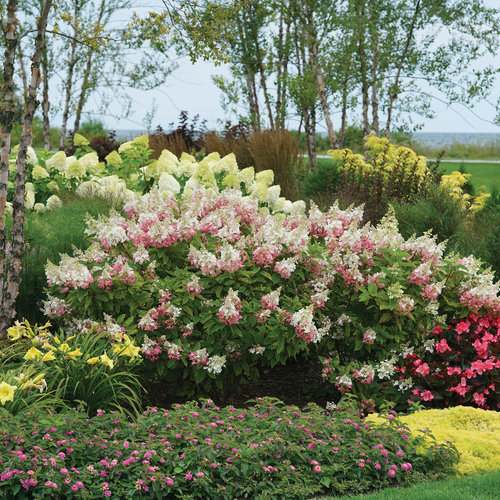
Pinky Winky Hydrangea (Hydrangea paniculata ‘DVPPinky’)
Panicle hydrangeas are the workhorses of the Wisconsin shrub border, and Pinky Winky stands out even in that reliable group. This Proven Winners selection produces enormous cone-shaped flower panicles that open white at the tip and age to deep pink from the bottom up, creating a two-toned effect that no other hydrangea can match. Thick, sturdy stems hold those big blooms upright without flopping, even after a thunderstorm.
Quick Facts
| Botanical Name | Hydrangea paniculata ‘DVPPinky’ (Pinky Winky®) |
| Plant Type | Deciduous Flowering Shrub |
| Mature Size | 6-8 ft. tall, 6-8 ft. wide |
| Hardiness Zone | USDA Zones 3-8 (outstanding in Zone 5b) |
| Sun Exposure | Full Sun to Part Sun (best color in full sun) |
| Soil | Average, well-drained; adaptable to most types |
| Bloom Time | Mid-summer through fall (July to frost in Wisconsin) |
| Flower Color | White aging to deep pink (two-toned) |
| Flower Size | 12-16 in. panicles |
| Growth Rate | Moderate to Fast |
Why This Plant for Wisconsin / Zone 5b
Hardy to Zone 3, Pinky Winky does not even blink at a Wisconsin winter. Like all panicle hydrangeas, it blooms on new wood, so even a brutal February will not cost you a single flower. The plant simply grows fresh stems in spring and blooms on schedule every summer.
The two-toned flower display is what sets Pinky Winky apart from other panicle types. As the season progresses, the lower florets on each panicle shift from white to a rich, rosy pink. Meanwhile, the tip keeps pushing new white florets. The result is a bicolor cone that looks different every week from July through October. That extended show carries a Wisconsin garden through the late-summer gap when many perennials have finished flowering.
Planting Instructions
When to Plant: Spring through early fall. Spring is ideal for root establishment.
Site Selection: Full sun gives the best flower color and the sturdiest stems. Light afternoon shade is fine, especially in southern Wisconsin. Avoid deep shade, which produces leggy growth and fewer blooms.
Spacing: Give Pinky Winky room. Plant 6 to 8 feet from other large shrubs or structures. This plant fills its space.
Hole Prep: Dig a hole twice the width of the container and the same depth. The top of the root ball should be level with the surrounding soil.
Watering In: Soak the root zone thoroughly at planting. Water deeply once a week for the first season.
Mulch: Apply 2 to 3 inches of bark mulch or wood chips. Keep mulch 3 to 4 inches away from the base of the stems.
Care Throughout the Season
Spring: Prune back by about one-third in late winter or early spring, just before new growth starts. Cut each stem back to a pair of healthy buds. This maintains a compact shape and promotes stronger, thicker stems that support the heavy flower panicles. A single application of balanced slow-release fertilizer in early spring is sufficient.
Summer: Water deeply during dry spells. Pinky Winky has average water needs, but prolonged drought can cause flowers to brown prematurely instead of developing their signature pink color. Enjoy watching the color transformation begin in late July and August.
Fall: The flower panicles deepen to a dark rose and eventually dry to a warm tan. Leave them on the plant for winter interest. They look striking against snow and provide visual structure in the bare garden.
Winter: No special protection required. The dried panicles can be left standing or removed at your preference. Major pruning waits until late winter.
Common Problems in Wisconsin
Flowers Not Turning Pink: The color change is a natural aging process, not a soil pH response. If flowers stay white longer than expected, drought or very cool summer temperatures may be slowing the transition. Consistent watering helps.
Floppy Stems in Shade: Pinky Winky has some of the sturdiest stems among panicle hydrangeas, but plants grown in too much shade may still lean. Move to a sunnier spot if this is persistent.
Leaf Spot: Occasional in wet summers. Good air circulation and avoiding overhead watering reduce the risk. Remove and discard affected leaves to prevent spread.
Deer: Panicle hydrangeas are not a preferred food, but hungry deer in winter may nibble stems. Fencing or repellent sprays protect young plants during their first couple of winters.
Companion Planting Suggestions
- Karl Foerster Feather Reed Grass (Calamagrostis x acutiflora) – Vertical counterpoint to the rounded shrub form
- Purple Dome Aster (Symphyotrichum novae-angliae) – Fall purple blooms at the feet of the pink-toned panicles
- Annabelle Hydrangea (Hydrangea arborescens) – White mopheads contrast with the pink-and-white cones
- Diablo Ninebark (Physocarpus opulifolius) – Dark burgundy leaves provide dramatic backdrop
- Sedum Autumn Joy (Hylotelephium ‘Herbstfreude’) – Pink fall flowers and succulent texture complement the late-season show
Design & Landscape Uses
Pinky Winky makes a bold statement as a specimen plant in a front yard or as the anchor of a mixed shrub border. Its size (6 to 8 feet in both directions) gives it the visual weight to hold a corner bed or frame a garden entrance.
A row of Pinky Winky along a fence line or property border creates a spectacular summer-to-fall hedge. The dried flower panicles extend the display well into winter. It also pairs well with ornamental grasses and late-blooming perennials for a border that peaks in August and September, when many gardens start to wind down.
Fun Facts
- The two-toned color effect happens because Pinky Winky has indeterminate flowering. New white florets keep emerging at the tip of the panicle while older florets at the base age to pink. The result is a living gradient that changes week by week.
- Soil pH has no effect on Pinky Winky’s flower color, unlike bigleaf hydrangeas. The pink develops from natural cell aging, not aluminum availability. You cannot turn these flowers blue.
- Pinky Winky was bred in Belgium by Johan Van Huylenbroeck and introduced by Proven Winners. The name comes from a character on the British children’s television show Teletubbies.
Find Pinky Winky Hydrangea at Heritage Hill Nursery
Want a shrub that puts on a color show from midsummer through the first frost? Stop by to see Pinky Winky and get our recommendations for the best spot in your yard.
Heritage Hill Nursery | 10801 Pleasant Valley, Cedarburg, WI 53012