
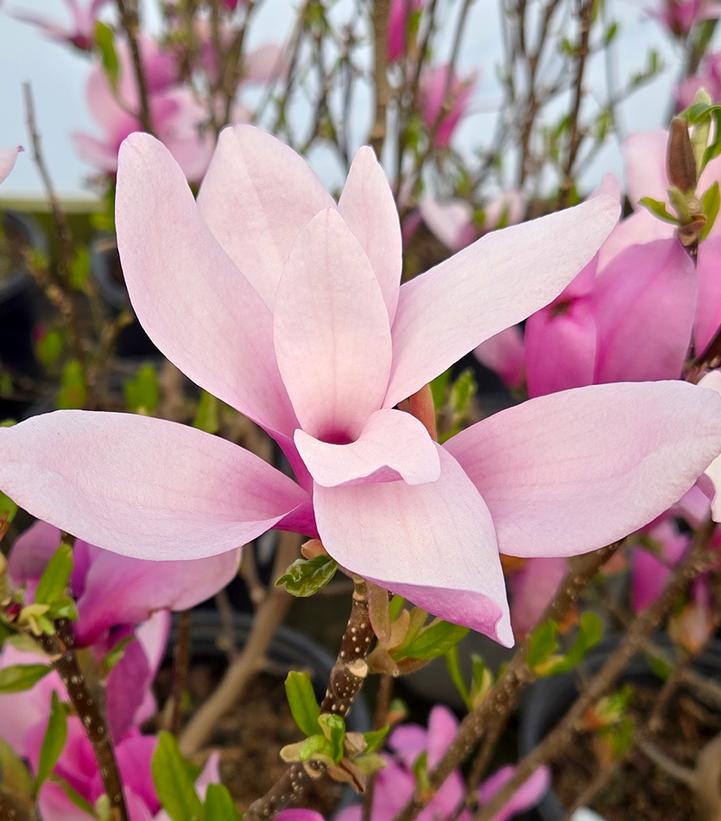
| Common Name | Jane Magnolia |
| Botanical Name | Magnolia x ‘Jane’ |
| Plant Type | Deciduous tree/large shrub |
| Hardiness Zone | 4-8 |
| Mature Size | 10-15 ft tall, 8-12 ft wide |
| Sun | Full sun to part shade |
| Soil | Moist, well-drained, slightly acidic |
| Bloom Time | Mid to late spring |
| Bloom Color | Purple-pink outside, white inside |
| Deer Resistant | Yes |
Why Jane Magnolia for Wisconsin
Jane is one of the “Little Girl” hybrid magnolias developed by the U.S. National Arboretum specifically to bloom late enough to avoid spring frost damage. That’s the problem with most magnolias in Wisconsin: they bloom early and a late frost kills the flowers. Jane waits until mid to late spring, after the worst frost risk has passed, then opens reddish-purple buds into tulip-shaped flowers that are purple-pink on the outside and white inside.
Planting Instructions
When: Spring. Magnolias establish best when planted in spring, giving roots a full season before winter.
Where: Full sun to part shade. Avoid south-facing locations where winter sun can warm buds prematurely. An east or north exposure is often better.
How: Magnolias have fleshy, sensitive roots. Handle the root ball carefully. Plant at the same depth. Do not disturb the roots after planting. Mulch generously.
Care Throughout the Season
Spring: Blooms mid-spring. Enjoy them. Occasional rebloom in summer.
Summer: Dark green foliage provides a dense, attractive canopy. Water during dry spells.
Fall: Leaves turn yellow-bronze before dropping. No pruning needed; magnolias have a naturally tidy form.
Winter: The fuzzy flower buds are visible on branch tips, a preview of next spring’s show.
Common Problems in Wisconsin
Late frost: Jane blooms later than most magnolias to avoid this, but a freak late frost can still damage flowers in some years. The tree itself is unharmed.
Root disturbance: Magnolias hate having their roots disturbed. Don’t dig, till, or plant aggressively under the canopy. Mulch is better than perennials at the base.
Companion Planting
Hellebore for early spring flowers at the base. Hosta for summer foliage under the canopy. Daffodils for spring color that doesn’t require root disturbance (plant before the magnolia). Boxwood for evergreen structure nearby.
Design and Landscape Uses
Specimen tree, corner planting, patio tree, or entry feature. The compact size (10-15 feet) makes it one of the best magnolias for residential yards. Beautiful near a front door, along a walkway, or anywhere you want spring drama without a 40-foot tree.
Fun Fact
Jane is one of eight “Little Girl” hybrid magnolias developed in the 1950s by Francis DeVos and William Kosar at the U.S. National Arboretum. All eight were named after women: Ann, Betty, Jane, Judy, Pinkie, Randy, Ricki, and Susan. The breeding goal was specifically to create magnolias that bloom late enough to avoid frost damage in the mid-Atlantic and Midwest.
Jane Magnolia is available at our Cedarburg nursery.
Plant now for spring flowers you can count on.