
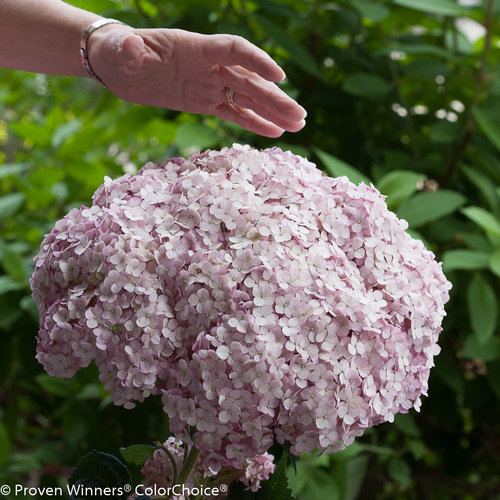
Incrediball Hydrangea (Hydrangea arborescens ‘Abetwo’)
Some hydrangeas demand fussy soil amendments, precise pH levels, and sheltered microclimates. Incrediball is not one of them. This improved selection of our native smooth hydrangea was bred by Proven Winners to fix the one real complaint gardeners had about the classic Annabelle: floppy stems. Incrediball delivers the same massive white snowball blooms on stems strong enough to hold them upright, even after a summer downpour.
Quick Facts
| Botanical Name | Hydrangea arborescens ‘Abetwo’ (Incrediball®) |
| Plant Type | Deciduous Flowering Shrub |
| Mature Size | 4-5 ft. tall, 4-5 ft. wide |
| Hardiness Zone | USDA Zones 3-8 (rock-solid in Zone 5b) |
| Sun Exposure | Full Sun to Part Shade (6+ hours ideal) |
| Soil | Average, well-drained; tolerates clay |
| Bloom Time | Early to mid-summer (June through August in Wisconsin) |
| Flower Color | Creamy white, aging to jade green |
| Flower Size | Up to 12 in. diameter |
| Native Range | Eastern North America |
Why This Plant for Wisconsin / Zone 5b
Incrediball blooms on new wood. That single fact makes it bulletproof in Wisconsin. Our harsh winters can kill stems back to the ground, and that is perfectly fine with this shrub. It regenerates from the roots each spring and blooms reliably every single summer, no matter what January threw at it.
Hydrangea arborescens is native to the eastern United States, meaning its genetics are adapted to the temperature swings, clay soils, and variable rainfall of our region. You will not find yourself babying this plant through a polar vortex. It also supports native pollinators, including bumblebees and smaller solitary bees that work the flower clusters throughout July and August.
Planting Instructions
When to Plant: Spring through early fall. Spring planting gives the roots a full season to establish before winter.
Site Selection: Full sun produces the most blooms and strongest stems. In southern Wisconsin, afternoon shade is acceptable and can help prevent wilt on the hottest days.
Hole Prep: Dig a hole twice the width of the container and the same depth. Do not plant too deep.
Soil Amendments: Work in compost if your soil is heavy clay. Incrediball is not picky, but good drainage helps.
Watering In: Water deeply at planting. Maintain consistent moisture (about 1 inch per week) through the first growing season.
Mulch: Apply 2 to 3 inches of shredded bark or leaf mulch. Keep mulch a few inches from the stems.
Care Throughout the Season
Spring: Cut the entire plant back by about one-third its total height just as new green buds begin to swell. This encourages strong new growth and builds up a woody framework over the years. Apply a balanced slow-release fertilizer once in early spring if desired.
Summer: Water deeply once a week, twice during hot dry stretches. Deadheading spent blooms can encourage a lighter second flush, though it is not required. Watch the flowers transition from creamy white to a soft jade green as the season progresses.
Fall: Leave the dried flower heads on the plant. They add winter texture to the garden and help protect the crown from extreme cold.
Winter: No special protection needed. The stems may die back partially or fully, which is normal. Resist the urge to prune until spring.
Common Problems in Wisconsin
Stem Flop After Heavy Rain: Less common with Incrediball than Annabelle, but possible in very shady sites. Moving to a sunnier location or supporting with a peony ring solves the problem.
Leaf Scorch in Full Sun: During extreme heat waves (95°F+), leaf edges may brown. Deep watering and afternoon shade reduce this. It is cosmetic and does not harm the plant long-term.
Deer Browse: Deer will occasionally nibble new growth in spring. Fencing or deer repellent sprays (applied early and reapplied after rain) are effective.
Powdery Mildew: Can appear in late summer if air circulation is poor. Space plants properly and avoid overhead watering in the evening.
Companion Planting Suggestions
- Hosta (Hosta spp.) – Shade-tolerant foliage contrast at the base
- Russian Sage (Perovskia atriplicifolia) – Airy purple spikes complement the white globes
- Astilbe (Astilbe spp.) – Feathery pink or red plumes for texture contrast
- Diablo Ninebark (Physocarpus opulifolius) – Dark burgundy foliage makes the white blooms pop
- Little Bluestem (Schizachyrium scoparium) – Native grass that turns copper in fall beside the green dried heads
Design & Landscape Uses
Incrediball is a natural fit for foundation plantings, mixed borders, and mass plantings along a fence line. A row of three to five shrubs creates a stunning summer hedge of white that requires minimal maintenance.
It also works well in a rain garden or low spot where water collects, as it handles brief wet periods without complaint. Pair it with dark-leaved shrubs like Diabolo ninebark or Summer Wine ninebark for dramatic contrast. The dried flower heads provide structure in the winter garden, especially when dusted with snow.
Fun Facts
- Incrediball blooms can reach nearly the size of a basketball, roughly 12 inches across. They contain about four times the number of individual florets as Annabelle.
- Hydrangea arborescens was one of the first American shrubs cultivated in European gardens, traveling across the Atlantic in the mid-1700s.
- Unlike bigleaf hydrangeas (H. macrophylla), the flower color of Incrediball is not affected by soil pH. The blooms will always be white to green, regardless of how acidic or alkaline your soil is.
Find Incrediball Hydrangea at Heritage Hill Nursery
Looking for a low-maintenance bloomer that thrives in Wisconsin without any fuss? Come see our selection of Incrediball hydrangeas and get expert advice on where to plant yours.
Heritage Hill Nursery | 10801 Pleasant Valley, Cedarburg, WI 53012