
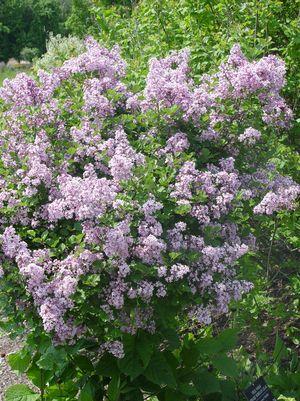
Dwarf Korean Lilac (Syringa meyeri ‘Palibin’) is a compact, fragrant flowering shrub for gardeners who want the scent and bloom of a traditional lilac without the size. It carries lavender flowers, a neat rounded form, and clean foliage that stays presentable long after the blooms finish.
Size and habit
Palibin matures at 4 to 6 feet tall and 5 to 7 feet wide, so it settles in wider than it is tall. Plan spacing with the spread in mind rather than the height, which is the most common mistake with this shrub. The form is dense and rounded and holds its shape with little or no pruning.
Bloom
Bloom comes in May, and Palibin flowers prolifically even as a young plant, which is unusual among lilacs. Many lilacs make you wait several seasons for a full show. Flower color is lavender, and the small tubular florets are carried in clusters across the whole plant. The fragrance is the classic lilac scent.
Growing conditions
Plant in full sun in well-drained soil. Palibin is hardy in zones 3 through 8, which puts southeastern Wisconsin comfortably inside its range with room to spare on the cold end. Full sun matters for bloom count: in too much shade the plant grows leggy and flowers less.
Clean foliage
One of the strongest arguments for Palibin over an older lilac is its foliage. The leaves are small and its foliage is not susceptible to powdery mildew, the disease that leaves many common lilacs looking grey and tired by August. Palibin stays clean through the season.
Pruning
If pruning is needed, prune immediately after flowering. This shrub blooms on old wood, so cutting it back in fall or early spring removes the buds that would have become next spring’s flowers. In most plantings little pruning is needed at all.
Where to use it
The compact form suits foundation plantings, mixed borders, and low hedges, and it works as a standalone accent where a full-size lilac would overwhelm the space. Planted in a row it makes a fragrant low hedge that needs very little upkeep.
At a glance
- Botanical name: Syringa meyeri ‘Palibin’
- Mature height: 4 to 6 feet
- Mature spread: 5 to 7 feet
- Hardiness zones: 3 to 8
- Bloom: May, lavender, fragrant
- Light: full sun
- Foliage resistant to powdery mildew
Companion planting
Palibin blooms in May and then holds the space as a clean green mound for the rest of the season, which makes it a useful backbone for a border that keeps going after the lilac finishes. Pair it with perennials that carry color through summer:
- Nepeta (catmint) for a long blue bloom that starts as the lilac fades
- Salvia ‘May Night’ for upright spikes against the lilac’s rounded form
- Allium ‘Millenium’ for globe flowers in mid to late summer
- Daylilies and other perennials to fill the mid-season gap
Ready to plant?
Dwarf Korean Lilac is in stock at the nursery. You can see current sizes and pricing on the Syringa meyeri ‘Palibin’ product page, or stop in and take in the scent for yourself when it comes into bloom in May.
If you want the lilac fragrance with repeat bloom through the season, look at the Bloomerang series instead, which is bred specifically to rebloom.