
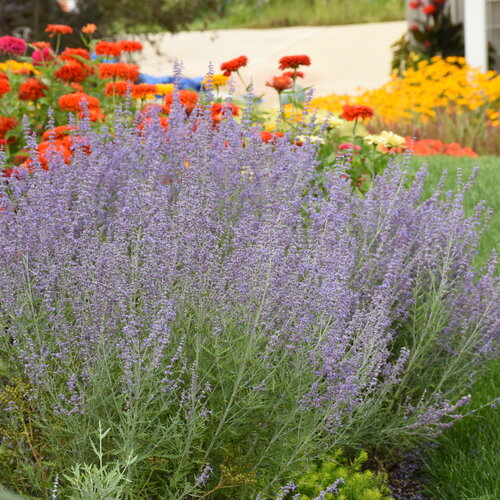
| Common Name | Denim ‘n Lace Russian Sage |
| Botanical Name | Perovskia atriplicifolia ‘Denim ‘n Lace’ |
| Plant Type | Herbaceous perennial |
| Hardiness Zone | 4-9 |
| Mature Size | 28-32 in tall, 34-36 in wide |
| Sun | Full sun |
| Soil | Well-drained, lean to average |
| Bloom Time | Mid to late summer |
| Bloom Color | Lavender-blue |
| Deer Resistant | Yes |
| Drought Tolerant | Yes |
Why Denim ‘n Lace for Wisconsin
Standard Russian sage gets tall and floppy. Denim ‘n Lace was bred to fix that. It tops out around 30 inches, holds itself upright without staking, and produces heavier flower coverage than the species. The silvery foliage and lavender-blue spikes create a haze of cool color from July through September. Deer and rabbits leave it alone. Once established, it handles drought without blinking.
Planting Instructions
When: Spring, after last frost.
Where: Full sun, hot spots. The hotter and drier the better.
How: Space 30-36 inches apart. Do not amend the soil or fertilize. Lean soil produces sturdier stems. Good drainage is essential.
Care Throughout the Season
Spring: Cut back to 6-8 inches in late spring once you see new buds on the stems. Do not cut back too early in spring; it’s one of the last perennials to show new growth.
Summer: Blooms mid-summer. No deadheading needed.
Fall: Leave the stems standing. The dried seed heads have winter interest.
Winter: Leave stems intact. They protect the crown from frost and look good with snow.
Common Problems in Wisconsin
Root rot: The number one killer. Avoid wet, heavy soil. Never overwater. If your soil is clay, plant in a raised bed or amend heavily with gravel.
Late emergence: Don’t panic in spring when it seems dead. Russian sage is always the last thing to wake up. Wait until late May to see growth.
Companion Planting
Coneflower for warm-tone contrast. Black-eyed Susan creates a prairie meadow effect. Sedum picks up the fall color baton. Ornamental grasses like Karl Foerster for vertical accents.
Design and Landscape Uses
Hot, sunny borders. Gravel gardens. Mass plantings along driveways. Mixed with ornamental grasses for a naturalistic look. The silver foliage softens any planting combination. Works beautifully against dark-foliaged shrubs like ninebark.
Fun Fact
Despite the name, Russian sage is not actually related to culinary sage (Salvia) and it’s not from Russia. The genus Perovskia is native to Afghanistan and Pakistan. The common name stuck because the foliage looks and smells somewhat sage-like. Denim ‘n Lace was a Proven Winners introduction.
Denim ‘n Lace is available at our Cedarburg nursery.