
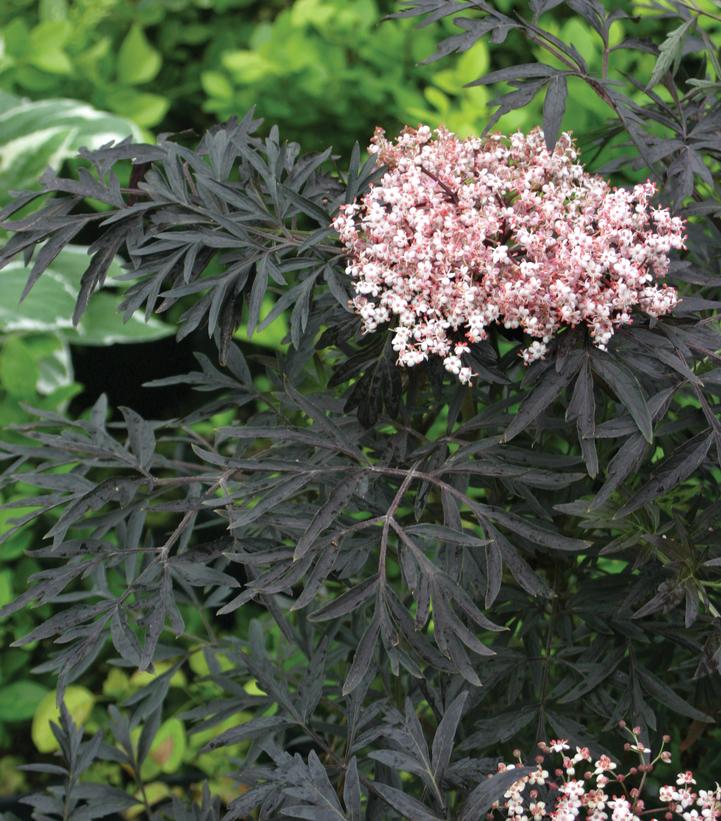
| Common Name | Black Lace Elderberry |
| Botanical Name | Sambucus nigra ‘Eva’ |
| Family | Adoxaceae |
| Plant Type | Deciduous shrub |
| Hardiness Zone | 4-7 (thrives in Zone 5b) |
| Mature Size | 6-8 ft tall, 6-8 ft wide |
| Sun Exposure | Full sun to part shade |
| Soil | Moist, well-drained |
| Bloom Time | Early summer |
| Bloom Color | Pink |
| Native To | Europe (cultivar) |
| Deer Resistant | Yes |
| Pollinator Friendly | Yes (bees, butterflies) |
Why Black Lace Elderberry for Wisconsin
Black Lace stands out in any landscape. The deeply dissected foliage looks like a Japanese maple from a distance, but this shrub is far tougher. It handles Wisconsin winters without hesitation and comes back strong every spring. The dark purple, almost black foliage holds its color all season. In early summer, large flat-topped clusters of pink flowers appear, followed by dark berries that attract birds.
Planting Instructions
When: Spring (late April to May) or early fall (September).
Where: Full sun produces the darkest foliage color. Part shade is fine but leaves will be more green than purple.
How: Dig a hole twice as wide as the root ball. Plant at the same depth. Water thoroughly and mulch 2-3 inches around the base.
Care Throughout the Season
Spring: New growth emerges with striking dark color. Prune to shape if needed. Black Lace blooms on new wood, so spring pruning is safe.
Summer: Enjoy the pink flower clusters in June. Water during extended dry spells.
Fall: Birds will clean up the dark berries. Foliage stays attractive until frost.
Winter: Cut back hard in late winter if you want to keep it compact. It responds well to aggressive pruning.
Common Problems in Wisconsin
Aphids: Elderberries can attract aphids on new growth. A strong spray of water usually knocks them off.
Suckering: This shrub spreads by root suckers. Remove unwanted shoots to keep it contained. In the right spot, this is actually a feature, not a problem.
Companion Planting
Karl Foerster Feather Reed Grass adds vertical contrast. Rozanne Geranium fills the base with blue flowers. Catmint provides a lighter color echo. Hydrangea paniculata varieties create a layered shrub border.
Design and Landscape Uses
Use Black Lace as a specimen plant where you want a bold color statement. It works as a focal point in mixed borders, a privacy screen (plant 4-5 feet apart), or a dramatic backdrop for lighter-colored perennials. The dark foliage makes everything planted in front of it pop.
Fun Fact
Black Lace was discovered as a chance seedling in Europe and introduced to the market by Proven Winners. The name comes from the lace-like quality of the deeply cut leaves. Despite its refined appearance, this is one tough plant.
Black Lace Elderberry is available at our Cedarburg nursery.
Stop by to see the foliage color in person.