
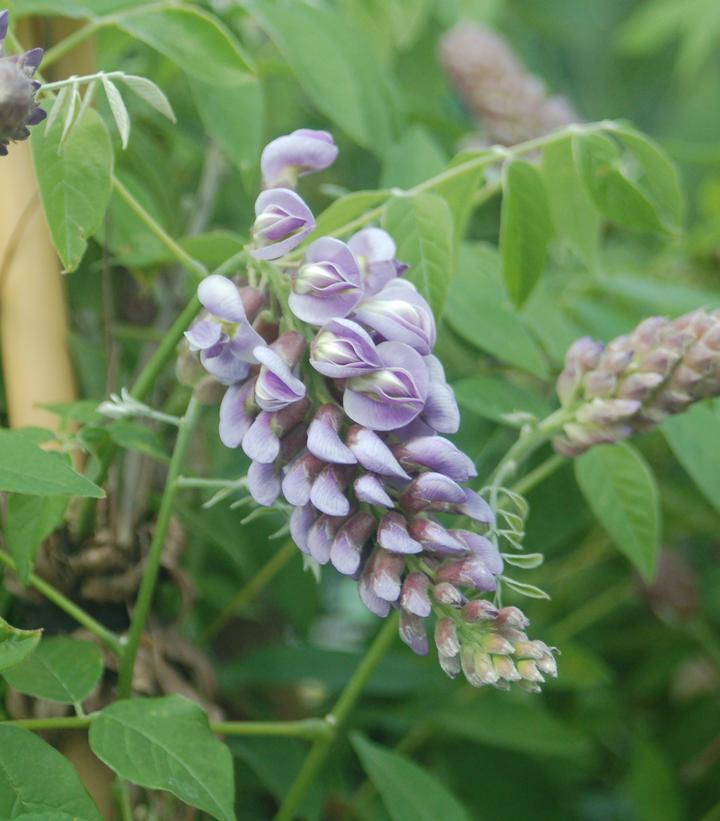
Amethyst Falls Wisteria (Wisteria frutescens ‘Amethyst Falls’)
Wisteria gets a bad reputation in gardening circles, and for understandable reasons. The Asian species (W. sinensis and W. floribunda) are aggressive invaders that swallow buildings, crush pergolas, and spread into wild areas. Amethyst Falls is the answer to every gardener who wants those cascading purple flower clusters without the destruction. This is a selection of our native American wisteria, well-behaved and perfectly suited to Wisconsin gardens.
Quick Facts
| Botanical Name | Wisteria frutescens ‘Amethyst Falls’ |
| Plant Type | Deciduous Flowering Vine (Native) |
| Mature Size | 15-20 ft. long (on support structure) |
| Hardiness Zone | USDA Zones 5-9 (reliable in Zone 5b) |
| Sun Exposure | Full Sun to Part Sun (best bloom in full sun) |
| Soil | Moist, well-drained; mildly acidic to neutral |
| Bloom Time | Late spring to early summer, with repeat bloom |
| Flower Color | Lavender-purple |
| Flower Clusters | 4-6 in. racemes, lightly fragrant |
| Growth Rate | Moderate (about 1/3 the rate of Asian wisteria) |
Why This Plant for Wisconsin / Zone 5b
The number one reason to choose Amethyst Falls over Asian wisteria: it is not invasive. Wisteria frutescens is native to the eastern United States and grows at roughly one-third the rate of its Asian cousins. You get the signature hanging flower clusters and twining habit without the vine taking over your neighbor’s fence, your roof, or the nearest forest preserve.
Zone 5b sits right at the northern edge of this vine’s range, which means site selection matters. A south-facing wall or fence gives Amethyst Falls the warmth it needs to bloom well and survive our coldest winters. The payoff is worth the thought: cascading lavender-purple flowers in late spring, often with a lighter repeat bloom in midsummer. And unlike Asian species that can take a decade to flower, Amethyst Falls typically blooms in its first or second year after planting.
Planting Instructions
When to Plant: Spring, after the last frost date has passed. This gives the vine a full growing season to root in before winter.
Site Selection: Full sun against a south- or west-facing wall, fence, or sturdy arbor. The reflected warmth from a building wall helps in Zone 5b. Make sure your support structure is solid; wisteria vines add weight as they mature.
Hole Prep: Dig a hole twice the width of the root ball. Plant at the same depth as the container. If planting near a wall, position the root ball 12 to 18 inches out from the foundation.
Support: Install a trellis, arbor, or wire system at planting time. Amethyst Falls is a twining vine that needs something to wrap around.
Watering In: Water deeply and regularly through the first growing season. Once established (after year two), it becomes moderately drought tolerant.
Mulch: Apply 2 to 3 inches of organic mulch around the base, keeping it away from the stem.
Care Throughout the Season
Spring: As new growth emerges, train young shoots onto your support structure. Amethyst Falls blooms on new wood, so any winter dieback will not prevent flowering. Apply a phosphorus-rich fertilizer (like bone meal) in early spring to encourage blooms. Avoid high-nitrogen fertilizers, which push leaf growth at the expense of flowers.
Summer: After the main bloom, watch for a lighter second flush of flowers. Prune back long, whippy shoots to maintain shape and encourage branching. Water during extended dry periods.
Fall: Reduce watering as the vine goes dormant. Clean up any fallen leaves. This is a good time to assess your support structure and make repairs before winter adds snow load.
Winter: In Zone 5b, some tip dieback is normal and expected. Do not prune until spring, when you can see exactly which wood is alive. A 3 to 4 inch layer of mulch over the root zone provides extra insulation.
Common Problems in Wisconsin
Winter Dieback: Zone 5b is at the edge of this vine’s cold tolerance. South-facing placement and winter mulching reduce the risk. Even with dieback, the vine typically regenerates from established roots.
No Blooms: Usually caused by too much shade, too much nitrogen fertilizer, or a vine that is still establishing. Give it full sun and phosphorus-heavy feeding. Patience helps: most plants bloom by year two.
Japanese Beetles: Can chew on leaves in July. Hand-picking or neem oil spray manages small infestations without harming pollinators.
Confusion with Asian Species: Make sure you are purchasing the correct species. Wisteria frutescens (American) has shorter flower clusters (4-6 inches) and blooms after leaves emerge. Asian species have longer racemes and bloom before leafing out. Buy from a reputable nursery to be certain.
Companion Planting Suggestions
- Clematis (Clematis spp., Zone 4-hardy varieties) – A second vine on the same arbor extends the bloom season
- Catmint (Nepeta x faassenii) – Purple-blue groundcover beneath the vine echoes the flower color
- Coral Bells (Heuchera spp.) – Colorful foliage at the base adds season-long interest
- Salvia (Salvia nemorosa ‘May Night’) – Upright purple spikes bloom at the same time
- Daylilies (Hemerocallis spp.) – Tough, reliable summer color to follow the wisteria bloom
Design & Landscape Uses
Amethyst Falls is perfect for covering an arbor, pergola, or garden gate with a romantic cascade of purple flowers. Its moderate growth rate means you can train it without fighting it, and it will not crush a standard residential arbor the way Asian wisteria would.
It also works well on a sturdy fence, a porch railing, or a trellis attached to a garage wall. In smaller gardens, you can even grow it as a freestanding standard (tree form) by staking a single stem and pruning the top into a rounded canopy. This technique creates a stunning focal point for a patio or courtyard.
Fun Facts
- Wisteria frutescens is native from Virginia to Florida and west to Texas. It was first described by Carl Linnaeus in 1753, making it one of the earlier North American plants cataloged by European botanists.
- American wisteria flowers are fragrant and attract hummingbirds, butterflies, and native bees. The vine is also a larval host for the silver-spotted skipper butterfly.
- You can tell American wisteria from Asian species by twining direction. W. frutescens twines counterclockwise, while Chinese wisteria (W. sinensis) twines clockwise.
Find Amethyst Falls Wisteria at Heritage Hill Nursery
Want the romance of wisteria without the invasive headache? Visit us to see Amethyst Falls in person and get planting advice tailored to your Zone 5b garden.
Heritage Hill Nursery | 10801 Pleasant Valley, Cedarburg, WI 53012